


Community Development
Investing in people, place, and, prosperity
The RRRC achieves the best outcomes by working in genuine partnership with researchers, governments, industry, Traditional Owners and communities across northern Australia, Torres Strait, and Papua New Guinea. Programs and partnerships are most effective when the needs of all sectors are considered in their design, delivery and communication.
Our approach is grounded in consultation, participation and education. We recognise that healthy ecosystems underpin prosperous communities, and that local people and industries are best placed to identify information gaps, regional challenges and cultural priorities. By embedding this knowledge with scientific expertise, we ensure outcomes are practical and relevant.
Capacity-building is central to our work. Programs that strengthen community and industry skills create lasting social, economic and environmental benefits. Local people are also uniquely positioned to collect data, monitor ecosystems and care for their environments when equipped with knowledge, training and resources.


Empowering women through education, training and employment opportunities

Creating partnerships that support prosperity and long-term sustainability

Providing practical knowledge that informs industry and community action

Supporting leadership in culture, science and environmental management
Recognised capability in:
Capacity Building
At RRRC, we recognise that environmental challenges cannot be separated from the social and economic realities of the communities that depend on natural resources. We believe lasting change occurs when people are equipped with the skills, confidence and opportunities to shape their own futures.
Through community-led development programs, RRRC works with local partners to build leadership, strengthen governance, improve livelihoods and create pathways to education and employment. By investing in people alongside environmental management, our programs deliver lasting social, economic and environmental outcomes.
Outcomes of our programs include:
-
More than 180 Community Rangers trained and employed
-
Community Ranger networks established across 40+ villages
-
Women and people with disabilities entering paid employment
-
Improved food security and nutrition outcomes
-
Better maternal and child health outcomes
-
Improved water, sanitation and hygiene practices
-
Stronger community governance and local leadership
-
Increased climate resilience and disaster preparedness
-
Sustainable marine resource management capacity developed
-
Lasting social, economic and environmental benefits delivered
Building resilient communities across the Far North and our neighbouring region

“It broke my heart how many women lost their babies at childbirth … Since the program came in, our women have been using modern birthing kits supplied by the program, and we female rangers teach the pregnant women ...”
Yawan Mut – Community Ranger, Mari village
.jpg)
“For the ranger program to be recognised in the communities, that their own citizens are taking ownership of helping to build their societies, has really brought them together and helped give hope to many in the Treaty Villages of the South Fly.”
Dave Rutherford – INLOC

“When I lost use of my legs after falling from a coconut tree in 2013, I cried for my legs – confident this was the end of me. But I was thrilled when offered the job of RSO in the ranger program. It has helped build my confidence as I can now also contribute to my family’s wellbeing through my income and that makes me very happy.”
Waidana Gauso – Ranger Support Officer, Mabaduan village

Education & Employment
RRRC recognises that education, training, and meaningful employment are essential foundations for strong communities and effective environmental stewardship. In remote and disadvantaged communities, access to training and employment opportunities remains limited, making targeted, culturally safe programs critical to long-term social and economic development.
Through partnerships with communities, industry and government, RRRC designs and delivers practical training, leadership and employment initiatives that create real pathways to work while building local capacity. These programs help strengthen confidence, economic participation and community resilience, while supporting sustainable management of natural resources.
Achievements of our programs include:
-
Over 50 Indigenous women achieving nationally recognised qualifications
-
Employment and enterprise pathways created in remote communities
-
TOPCOTS trainees gaining qualifications and professional field experience
-
Traditional Owners employed in environmental management roles
-
Community Ranger programs established across more than 40 PNG villages
-
Culturally safe training tailored to local community needs
-
Increased leadership, confidence and workforce participation outcomes
-
Practical skills development supporting long-term community resilience
Addressing social and economic challenges

"[Deadly Women] was very important for me… I’ve never done any training in Indigenous tourism and culture before so I’ve learnt a lot and it’s been amazing. I definitely want to continue with my self-development. I would love to continue training in finance and business. I’d like to continue and receive higher education."
Jdaler Rosas – Deadly Women Graduate

"Graduating feels really good… My goal is to do business at home on country… it’s given me ideas on how to get it started… possibly ranger work, possibly art with my cousins… Most of us are really timid and shy… to get to learn technology, learning how to write and talk. It boosts my confidence."
Melanie Henry – Deadly Women Graduate
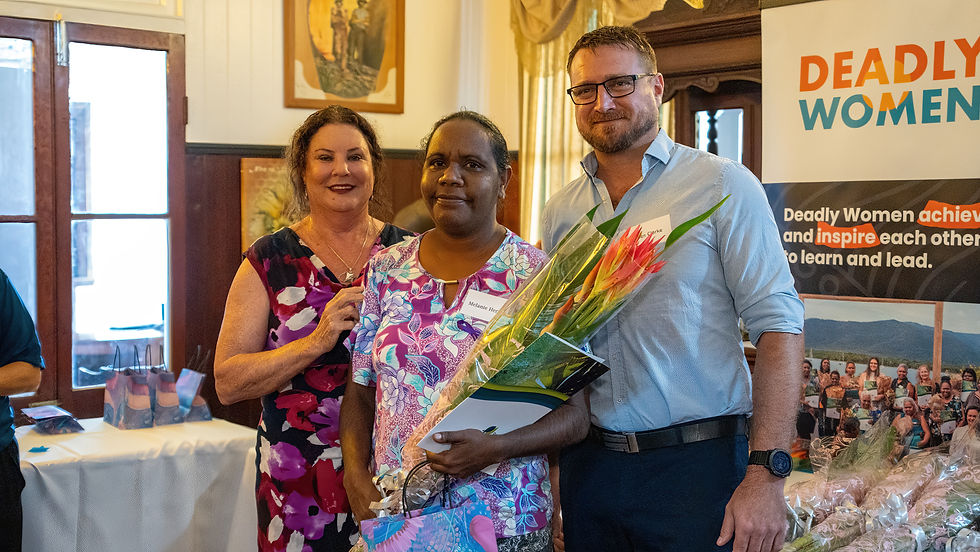
"I’m very, very proud of the work we have done together… it is a privilege… a thrill to see the growth and commitment as the ladies progress through the program… It can be quite nerve wracking for some to sit in a classroom. Some haven’t done it for 40 years. We put technology and new big words in front of them. Myself and my team really adapt to the lady in front of us. We make sure the way we deliver is a way they can learn from."
Samantha Walker – Deadly Women Trainer & Program Manager

Agriculture
RRRC partners with farming communities, industry bodies, and researchers to ensure environmental outcomes are practical, evidence-based and beneficial to both agriculture and natural ecosystems. By combining scientific research with grower knowledge and on-ground implementation, RRRC helps industries improve productivity while reducing environmental impacts.
This collaborative approach has been applied across water quality improvement, landscape restoration, monitoring and extension programs throughout northern Australia. Through trusted partnerships, RRRC supports the adoption of innovative practices that deliver measurable environmental and economic benefits.
Achievements of our programs include:
-
More than nine tonnes of nitrogen reductions annually
-
Water quality improvements across 11,000 hectares of farmland
-
Grower-led monitoring and decision-support programs established
-
Wetland restoration and sediment retention projects delivered
-
Partnerships with CANEGROWERS, AgForce and Growcom
-
New information guiding sustainable farm management
-
Banksia Award-winning approaches to agricultural sustainability
Evidence-based solutions for sustainable agriculture

"Growers were a part of the system – the sampling and the integrity of the data – and so they never doubted the results... When we started this journey it was new. Now it’s an accepted template across the industry.”
Stephen Calcagno – Chairman, CANEGROWERS Cairns

“One of the best things about this project is that it’s helping paint a picture of where water quality issues in the catchment are really originating.”
Dr Aaron Davis – Principal Research Scientist, JCU TropWATER

"Some of the best environmental solutions are surprisingly simple. The challenge is understanding the system well enough to know where they will work."
Dr Rick Abom – Program Manager, Russell–Mulgrave Reef Coastal Restoration Program

Tourism
RRRC works with tourism operators, researchers and managers to translate environmental knowledge into practical guidance that supports sustainable tourism. By connecting science with industry needs, RRRC helps operators understand environmental change, adapt to emerging challenges and deliver high-quality visitor experiences.
Research programs are developed in partnership with industry and management organisations to ensure outcomes are both scientifically robust and operationally relevant. This collaborative approach strengthens environmental stewardship while supporting the long-term resilience of northern Australia’s tourism sector.
Achievements of our programs include:
-
Tourism research informing management and industry decisions
-
Long-term partnerships with AMPTO and tourism operators
-
Tour Guide Handbook used across the Wet Tropics
-
Research supporting reef and rainforest visitor experiences
-
Industry access to contemporary environmental knowledge
-
Science communication resources tailored to tourism audiences
-
Strong collaboration between tourism, science and management
Science, stewardship, and sustainable tourism

“Tourism operators are not just visitors to the Reef – they are among its most active stewards. Their local knowledge, ongoing observations and close connection to reef sites make them valuable partners in conservation, management and scientific research.”
Dr Sheriden Morris – Managing Director, RRRC

“RRRC has built strong partnerships between researchers and tourism operators, ensuring industry knowledge helps shape research and research outcomes are shared back with industry.”
Col McKenzie – Association of Marine Park Tourism Operators (AMPTO) (Retired)

First Nations
RRRC works alongside Aboriginal and Torres Strait Islander peoples and organisations to support Indigenous leadership in research, environmental management and capacity building. Through long-term partnerships, RRRC helps create opportunities for First Nations peoples to identify priorities, guide decision-making and lead the stewardship of Country and Sea Country.
By bringing together cultural knowledge, community leadership and scientific expertise, RRRC supports programs that strengthen Indigenous authority, build skills and contribute to lasting environmental, cultural and socioeconomic outcomes.
Achievements of our programs include:
-
Indigenous-led research frameworks supported and advanced
-
Reef 2050 Traditional Owner Aspirations Project delivered
-
70 Sea Country groups engaged in Reef planning
-
Muugar Saltwater Foundation governance and capacity supported
-
Indigenous leadership in research and environmental management strengthened
-
Traditional Knowledge informing environmental decision-making
-
Strong partnerships between First Nations peoples and researchers
Indigenous leadership in science and environmental management

“Healthy Country, strong culture and resilient communities are inseparable. Lasting environmental outcomes are achieved when Traditional Custodians are empowered to lead.”
Muugar Saltwater Foundation Partnership

“The strongest outcomes come when Indigenous knowledge and western science work together with equal respect. Both have a role to play in caring for Country and protecting the Reef.”
Duane Fraser – Wulgurukaba and Bidjara Traditional Custodian

